Apple body shape outfits
Fullest through the middle, often with narrower legs. Necklines, layers and waistbands that work with that shape, and why.
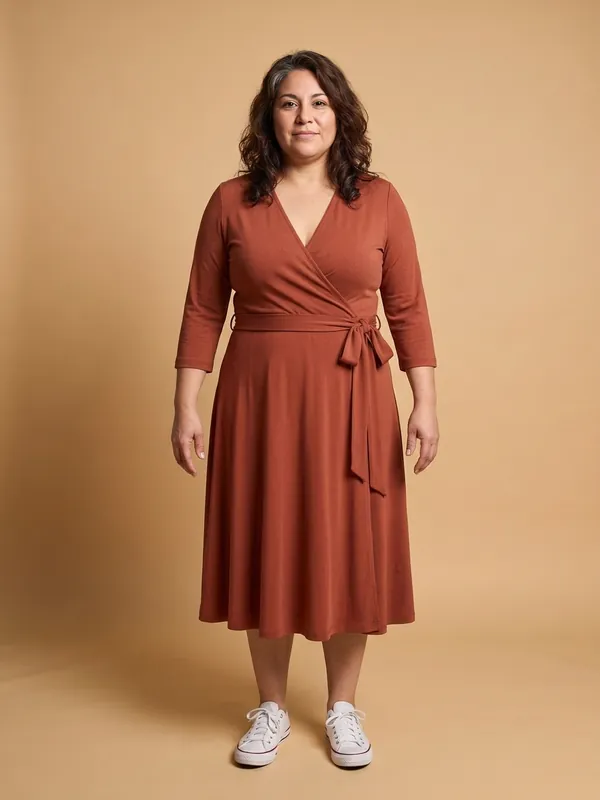
An apple shape, also called round or O-shape, carries its fullness through the middle: the waist measures close to the hips, or more, and close to the bust. Shoulders can be broad or narrow, the bust is often full, and many apple shapes have comparatively slim legs and a less rounded seat.
Apple is a shape, not a size. Slim people can be apples and plus-size people can be any shape. The ideas below are about proportion and comfort, and they work across the size range.
What makes an apple shape
On the measurement card, apple means your waist is at least 95% of your hips and at least 85% of your bust. With hips of 110 cm, a waist of 104.5 cm or more (95%) qualifies, as long as the bust is not so much larger that the waist drops below 85% of it. The calculator checks this rule first, so a full middle takes precedence over the bust-to-hip comparison.
If you entered a high hip that is larger than your hip, which can happen when fullness sits around the tummy and upper hip, the calculator uses the high hip in place of the hip. That number better reflects the widest part of your lower body.
Decide what you want to emphasize
- A long vertical line. V-necks, open layers, long necklaces and unbroken color all draw the eye up and down rather than across the middle.
- Legs. If your legs are narrower than your middle, they are a natural place to show shape.
- Neckline and shoulders. A good neckline brings attention to the face and collarbones.
- Comfort. Waistbands that dig in are uncomfortable on any body. A lot of good apple advice is simply about where fabric should sit so it does not.
Some people with an apple shape like a fitted knit that shows the belly as it is. That is just as valid a choice as everything below.
Tops and necklines
- V-necks, scoop necks and wrap fronts open up the chest and create a vertical line from the face down. A shirt worn with two buttons open does the same thing.
- Fabric with drape (jersey, crepe, viscose, soft cotton) skims the middle and moves with you. Very stiff fabrics stand away from the body and add bulk; very thin, clingy ones show every fold.
- Length: a top that ends at or just below the hip, with a straight hem, keeps a clean line. Tops that stop at the fullest part of the middle draw a horizontal line across it.
- Empire seams, which sit just under the bust, mark the narrowest point of the torso for many apple shapes and let the fabric fall from there.
- If shirts gape between buttons at the bust, look for cuts with more room in the body, or a fly-front placket, where a strip of fabric covers the buttons.
Layers
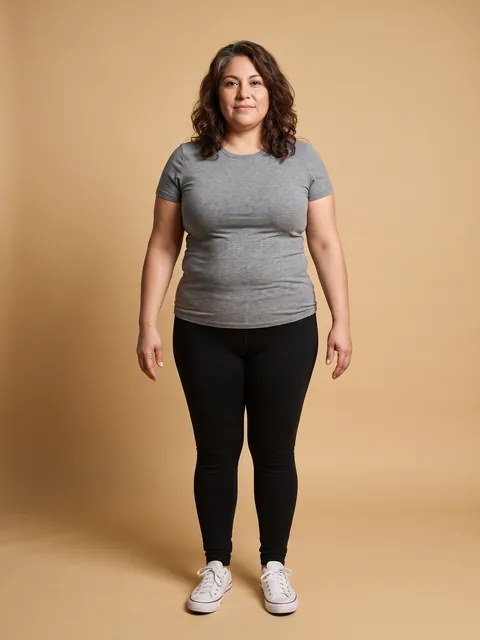
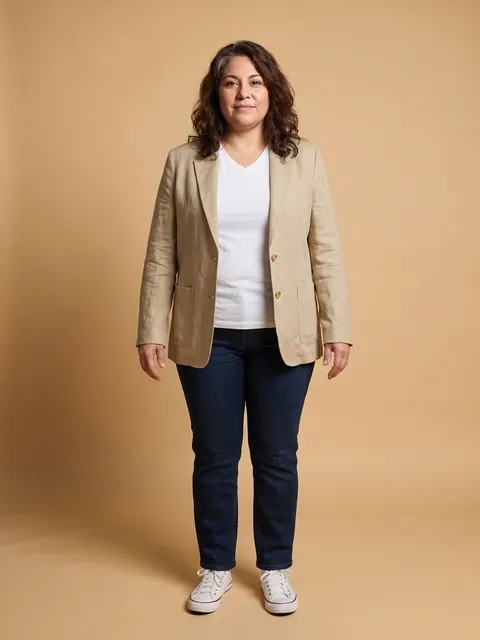
An open layer is the most useful single piece for an apple shape. The two front edges of an open blazer, cardigan or long duster make two vertical lines from shoulder to hip, and the gap between them reads as a long, narrow panel.
You can see this in the try-on comparison below. Buttoned, a jacket has to stretch across the fullest point; worn open, the same jacket hangs straight from the shoulder. Single-breasted jackets with a lower button stance work better than double-breasted ones, which add a layer of fabric across the middle.
Trousers and skirts
- Straight, slim and bootcut legs show the shape of the leg. Wide legs work too, especially in fabrics that drape.
- Rise and waistband: a mid or high rise that sits above the fullest part of the tummy usually stays put and does not roll. Flat-front waistbands, or ones with elastic at the back only, are comfortable and look smooth under a top.
- Many apple shapes fall between sizes: trousers that fit the waist are loose in the seat and thigh. Buy for the waist and have the legs taken in, or look for brands that cut a straighter hip.
- Skirts: A-line and straight skirts at or just below the knee show the legs. Skirts with a flat front and a soft waistband are easiest to wear with a top tucked or out.
Dresses
- Wrap dresses combine a V-neck with a tie that you can place where it is comfortable, at the natural waist, just below the bust or loosely at the side. The rust jersey dress in the photo at the top of this page ties at the side, and the fabric falls straight from there.
- Shift and A-line dresses skim straight past the middle.
- Empire-line dresses start the skirt just under the bust.
- Shirt dresses work worn open at the neck, with the belt left loose or swapped for an open layer.
Details that help
- A column of color: top and trousers in the same or similar color, with an open jacket in a different one, makes a long unbroken line.
- Vertical detail: a long pendant necklace, a scarf left hanging open, vertical seams or pinstripes.
- Belts are optional. Some apple shapes like a narrow belt just under the bust or a loose one at the high hip; few find a belt at the natural waist comfortable.
For men: the oval shape
On the men’s card, oval means your waist is at least 95% of your chest: the middle is the fullest part. It is common, often comes with strong legs and shoulders, and is easier to dress once the fit is right.
- Open layers again. An open overshirt, cardigan or unstructured blazer creates the same two vertical lines described above. Leave single-breasted jackets unbuttoned when standing if they pull.
- Collar open. An open collar or a V-neck sweater draws a V toward the face.
- Shirts with room in the body. Classic or regular fits hang straight from the chest. Slim fits pull across the middle and show where the buttons strain.
- Trousers at the natural waist. Trousers worn low under the belly tend to slide down. A slightly higher rise sits above it and stays put; some men find braces (suspenders) more comfortable than a belt for this reason.
- Darker, plain tops and vertical texture (cord, fine pinstripe) keep the line long. Horizontal stripes across the middle do the opposite.
If you are close to another shape
If your bust is clearly larger than your hips and your waist is only just inside the apple rule, the inverted triangle guide will also be relevant. If your measurements are fairly even all the way down, look at the rectangle guide.
See a wrap dress or an open blazer on you
Upload a photo of yourself and a photo or shop link of a garment; FitInView shows you wearing it. Your photos are private to your account.