Rectangle body shape outfits
Bust, waist and hips fairly even. Two ways to dress it, clean straight lines or a created waist, and when to use each.
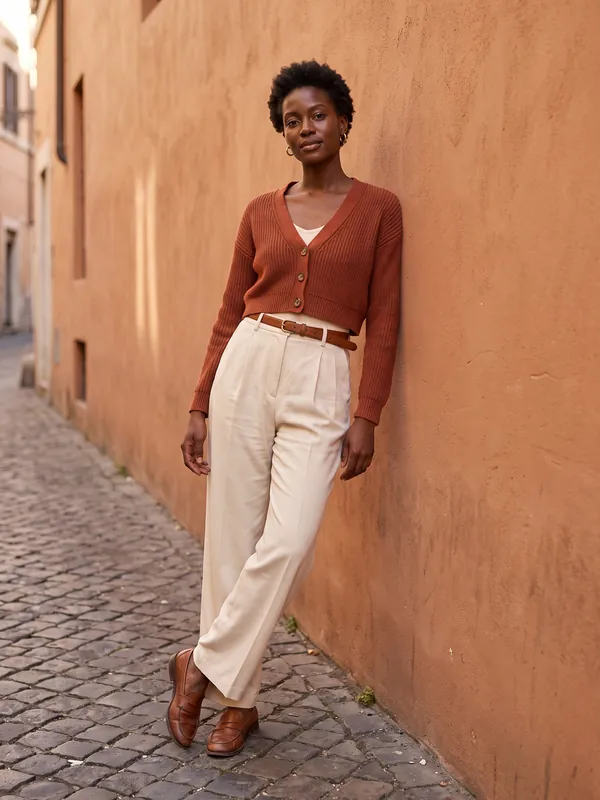
A rectangle shape, also called straight, banana or H-shape, has a bust, waist and hips that are fairly even, with a gentle waist rather than a sharp one. It is common among athletic and long-limbed builds, and at every size.
Rectangle advice is often written as if the goal were to fake curves. That is one option. The other is to wear the shapes that straight lines suit best, which is most of what is in fashion at any given time: boxy shirts, wide trousers, slip dresses, oversized blazers.
What makes a rectangle shape
On the measurement card, rectangle is what is left when none of the other rules apply. Your bust and hips are less than 5% apart, your waist is less than 25% smaller than the smaller of the two, and your waist is below 95% of your hips (otherwise it would be apple). 90 / 78 / 92 cm is a typical example: the waist is about 13% smaller than the bust.
Because rectangle covers a wide band, from a waist just over 5% smaller than your hips to one almost 25% smaller than your bust or hips, it is worth looking at your actual numbers. Near the 25% line, you share a lot with the hourglass. Near the 95% line, you have more in common with the apple.
Decide what you want to emphasize
- Clean lines. Column dressing, boxy tailoring, minimal shapes. Straight bodies carry them without the fabric pulling anywhere.
- A waist. Belts, peplums, wrap shapes and cropped-over-high-waisted combinations all create one.
- Volume and texture. Pleats, ruffles, chunky knits, layers. You have room to add shape where you want it.
Tops
- Boxy tees, oversized shirts and straight knits hang cleanly from the shoulder. Tuck the front if you want a waistline.
- Peplums, wrap tops and ruched sides add curve at the waist and hip.
- Necklines: almost any works, including crew, cowl, boat, square and polo. A cowl or a ruffled neck adds softness and some volume at the bust if you want it.
- Cropped tops over high-waisted bottoms put a hem right where a waist would be. The rust cardigan in the photo at the top of this page does this: it stops right at the belt of the trousers.
Trousers and jeans
- Wide-leg pleated trousers add volume at the hip with the pleats and below with the leg. With a belt and a cropped top, as in the photo, they create a waist from both directions.
- Straight, barrel and cargo cuts suit straight hips well, because there is no curve for the fabric to pull across.
- Low and mid rises work as well as high ones. You can choose the rise for the look rather than for fit.
- Because the waist-to-hip difference is small, standard sizing usually fits without gaping. That is one of the practical perks.
Skirts and dresses
- Slip dresses and shift dresses drop straight from the shoulder or bust and suit a straight frame very naturally.
- Shirt dresses can be worn loose or belted, depending on whether you want a waist that day.
- Drop-waist dresses put the seam at the hip, which lengthens the torso.
- Pleated, tiered and bubble skirts add volume at the hip; a slip skirt keeps things sleek.
- Wrap dresses create a waist with the tie and a V at the neck.
Jackets and coats
- Boxy and oversized blazers sit well on straight shoulders and fall without pulling.
- Cropped jackets (denim, tweed, bomber) mark a waistline with the hem.
- Belted trench coats and wrap coats create a waist in outerwear.
- Double-breasted jackets add a little width across the chest, which some rectangle shapes like for balance.
Belts and details
If you want to mark a waist with a belt, place it at the narrowest point you have, even if that point is subtle, and pull the fabric above it slightly loose so it blouses over. Wider belts make a stronger statement; a thin belt, like the one in the photo at the top of this page, does it quietly. Texture and pattern (a knit with a cable, a print skirt) also add dimension without needing a curve.
For men: the rectangle shape
On the men’s card, rectangle means your waist is more than 88% and under 95% of your chest: shoulders, chest and waist are close to even. Many lean and long-limbed men fall here, and so do plenty of solidly built ones.
- Structure at the shoulder. Jackets with a defined shoulder and a little waist shaping add the taper the body does not have.
- Detail across the chest. Chest pockets, a yoke, a horizontal stripe or a contrast panel at the top add width up there.
- Layering. A tee under an open overshirt, a collared shirt under a crew neck sweater, a vest under a jacket: layers build shape on top.
- Double-breasted jackets and peacoats add width across the chest. On a rectangle frame they balance well.
- Trousers: straight and slightly tapered legs. Skinny trousers can make the top look narrow by comparison; very wide legs suit you if the top has some structure too.
- Fit: slim-fit shirts often fit rectangles well because there is little difference between chest and waist to accommodate.
If you are close to another shape
If your waist is near the 25% line, read the hourglass guide. If your hips or bust are just under the 5% line, the pear or inverted triangle guides will have useful ideas too.
Try boxy or belted on your own photo
Upload a photo of yourself and a photo or shop link of a garment; FitInView shows you wearing it. Your first try-on is included with a free account.